
The Acceleration Trap
Why Civilization Must Adapt While the Race Continues

The AI War Chronicles — Episode CXVIII
Dispatches from the Frontlines of the AI Era
Substrate Economics Series
If you read AI War Chronicles, you will:
* See what becomes non-optional before everyone else
* Spot what gets replaced before it happens
* Understand where power is moving — and why
---
⸻
The natural response to accelerating artificial intelligence is simple.
Slow down.
Pause.
Give institutions time to adapt.
Allow governance to catch up.
Reduce the pressure.
If intelligence is improving faster than civilization can absorb it, slowing the rate of improvement seems like the obvious solution.
There is only one problem.
Civilization is not a single actor.
It is a competitive system.
Nations compete.
Companies compete.
Military powers compete.
Technological ecosystems compete.
And within competitive systems, the optimal outcome for everyone is often different from the optimal outcome for each participant.
⸻
This is the Acceleration Trap.
Anthropic’s recent findings provide a glimpse into why it matters.
As of 2026, Claude is authoring more than 80% of the code merged into Anthropic’s codebase.
Engineers are shipping roughly 8× more code.
AI is increasingly contributing to research and experimentation.
The development cycle is compressing.
Intelligence is helping create more intelligence.
As argued in The Synchronization Barrier, this creates adaptation pressure.
But adaptation pressure alone does not explain the future.
The more important question is:
Why doesn’t civilization simply reduce the pressure?
The answer may be competition.
⸻
The United States continues tightening restrictions on advanced AI chips and compute access for Chinese entities, treating frontier AI infrastructure as a strategic national-security asset.
China, meanwhile, is accelerating efforts toward domestic AI capability, semiconductor independence, and technological self-sufficiency.
Countries across the world are launching sovereign AI initiatives because dependence on foreign intelligence infrastructure is increasingly viewed as a strategic vulnerability.
The United Arab Emirates has announced plans involving roughly $200 billion in AI-related investments.
Saudi Arabia has signed major AI agreements worth hundreds of billions of dollars with global technology partners.
⸻
The private sector is behaving the same way.
Goldman Sachs estimates that AI-related spending by Microsoft, Amazon, Alphabet, and Meta could reach approximately $5.3 trillion through 2030.
Analysts estimate that these companies alone may spend roughly $725 billion on AI infrastructure in 2026.
None of these actors are behaving as if slowing down is a realistic option.
They are behaving as if falling behind is unacceptable.
That distinction matters.
Because it reveals the underlying logic of the system.
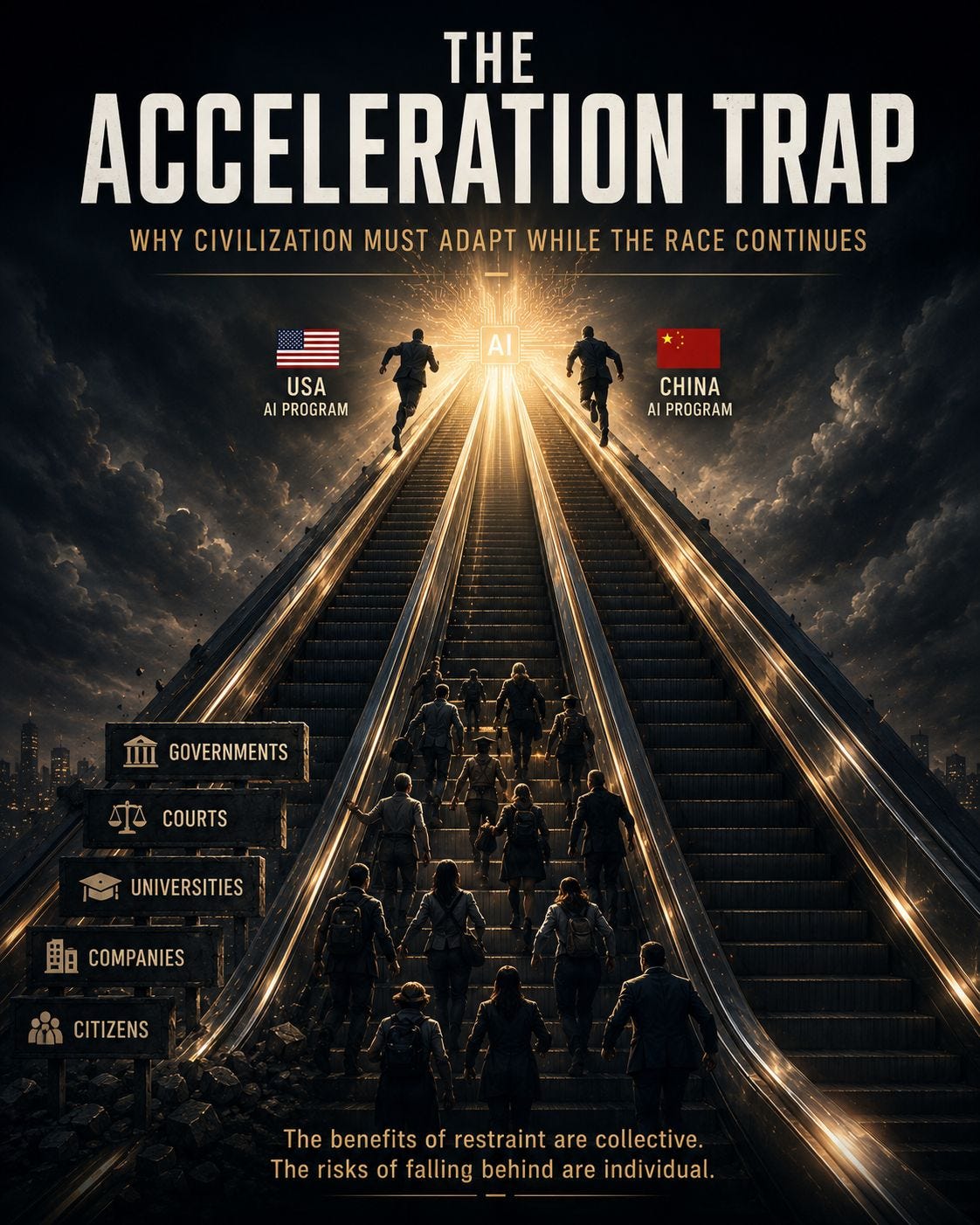
The benefits of restraint are collective.
The risks of falling behind are individual.
⸻
That is the Acceleration Trap.
Every participant would benefit from a world that adapts more slowly.
Yet no participant can confidently slow down on their own.
The moment one actor slows while another continues, the balance changes.
The challenge is no longer technological.
It is game-theoretic.
And game-theoretic problems are significantly harder than technical problems.
For most of history, civilization adapted between waves of change.
A major technology appeared.
Institutions adjusted.
Organizations reorganized.
Laws evolved.
Culture adapted.
Then the next wave arrived.
⸻
The AI era may be different.
Anthropic’s data suggests intelligence is beginning to accelerate the production of intelligence itself.
Geopolitical competition suggests that acceleration is unlikely to pause.
For the first time, civilization may be forced to adapt during the wave rather than between waves.
⸻
That distinction matters.
Because institutions were designed for periods of relative stability.
They were not designed for environments in which the underlying capability changes faster than the institution itself.
The challenge is no longer merely technological.
The challenge is civilizational.
This is also why the Civilizational Response becomes unavoidable.
Previous essays in this series described the pressure.
The Acceleration Trap explains why the pressure persists.
Together they suggest that the defining challenge of the AI era is no longer intelligence itself.
It is civilization’s ability to adapt under conditions of permanent acceleration.
This changes the role of governance.
Governance is no longer primarily about preventing acceleration.
Governance becomes the mechanism that allows civilization to survive acceleration.
Trust systems.
Verification systems.
Synchronization systems.
Legitimacy systems.
Containment systems.
These are no longer optional layers.
They become adaptation infrastructure.
Civilization’s response to permanent acceleration.
⸻
Viewed through this lens,
the AI era begins to resemble previous geopolitical competitions.
Not because AI is equivalent to nuclear weapons.
Not because AI is equivalent to the space race.
But because the underlying incentive structure is familiar.
The benefits of restraint are shared.
The risks of falling behind are concentrated.
That combination creates persistent pressure to continue.
This reveals something deeper about the Civilizational Response arc.
The purpose of civilization’s response is not to stop intelligence.
It is to absorb intelligence.
The purpose of governance is not to halt acceleration.
It is to preserve stability while acceleration continues.
The purpose of synchronization systems is not to slow reality.
It is to help civilization keep pace with reality.
⸻
Which leads to a troubling possibility.
The future may not be defined by a race toward artificial intelligence.
It may be defined by a race between intelligence acceleration and civilizational adaptation.
And those are not the same thing.
Anthropic’s data suggests intelligence is accelerating.
Geopolitical competition suggests that acceleration is unlikely to stop.
The question is whether civilization can build synchronization, governance, trust, and legitimacy quickly enough to keep pace.
Because if acceleration continues—and competitive systems suggest it will—the challenge is no longer deciding whether the race should happen.
The challenge is learning how to survive it.
⸻
The AI era may not be a story about stopping acceleration.
It may be a story about civilization adapting while acceleration continues.
Intelligence creates adaptation pressure.
Competition prevents adaptation pressure from slowing down.
Civilization must adapt during the wave rather than between waves.
Civilizational response becomes the only remaining path.
⸻
🔁 Share
***If this framework helped you see AI differently, share it with someone thinking about the future of technology.