
The Agentic Bottleneck
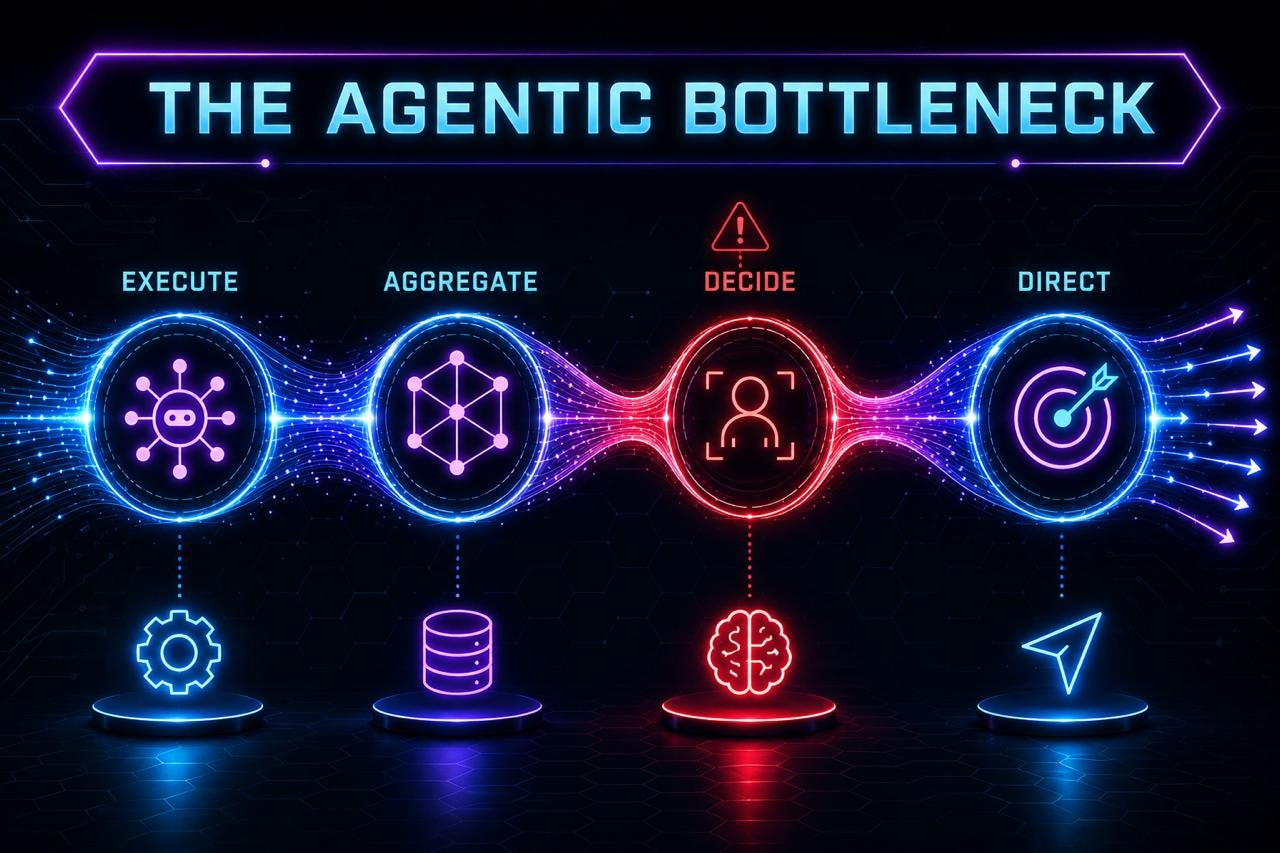
Why the Next AI War Is About Trusted Execution

The AI War Chronicles — Episode XCVI
Dispatches from the Frontlines of the AI Era
Substrate Economics Series
If you read AI War Chronicles, you will:
* See what becomes non-optional before everyone else
* Spot what gets replaced before it happens
* Understand where power is moving — and why
---
⸻
Everyone is talking about agentic AI as if the hard part is building smarter models.
That is no longer the real bottleneck.
The real bottleneck is whether organizations trust AI systems enough to let them operate inside production environments without constant human supervision.
That is a much bigger threshold.
Because the moment AI stops answering questions
and starts executing actions,
the structure of the organization itself begins to change.
A recent enterprise study from Sinch revealed something extremely important:
74% of enterprises have already rolled back or shut down a live AI customer-communication agent after deployment.
At the same time, 62% already have AI agents operating in production environments.
That combination matters.
⸻
The transition has already started.
But the infrastructure required to safely govern autonomous execution remains immature.
Not because the models failed benchmarks.
Not because the demos looked weak.
Because operating inside real systems is fundamentally different from generating impressive outputs.
The moment AI starts:
executing workflows,
routing decisions,
interacting across enterprise software,
handling operational exceptions,
and coordinating actions without waiting for humans at every step,
the problem changes completely.
The bottleneck stops being intelligence.
It becomes trust.
⸻
For the past few years, most AI systems existed primarily at the information layer.
Search engines retrieved information.
Chatbots answered questions.
Copilots assisted workers.
But agentic systems operate at the execution layer.
And execution changes everything.
Because once organizations trust AI systems enough to act inside operational environments,
human involvement stops being required at the same level it once was.
That is where the real disruption begins.
Not “AI becomes conscious.”
Not “AI becomes superintelligent.”
But:
systems stop requiring humans at the same level they once did.
⸻
That is the shift most people still underestimate.
And the signals are already visible.
Microsoft increasingly frames enterprise AI around “systems of action,” multi-agent orchestration, and autonomous business processes instead of simple copilots.
Salesforce openly describes agentic AI as “digital labor.”
At the same time, enterprise deployment studies show that most organizations still remain trapped at shallow deployment levels:
AI assistants,
AI compensators,
or limited orchestration systems.
Very few organizations have reached true multi-agent operational coordination.
⸻
That gap matters.
Because capability is scaling faster than institutional trust.
The models are improving rapidly.
But most organizations still do not fully trust autonomous execution inside critical systems.
That may become one of the defining infrastructure bottlenecks of the AI era.
Because the next strategic layer in AI may not be intelligence itself.
It may be trusted execution.
⸻
That means the critical systems increasingly become:
orchestration,
auditability,
observability,
execution tracing,
rollback systems,
human override layers,
and operational verification.
⸻
In other words:
trust becomes infrastructure.
And infrastructure is where power compounds.
⸻
This is why the agentic transition matters far beyond technology.
Once organizations trust AI systems enough to execute operational workflows,
the company itself starts reorganizing around AI execution.
Management layers compress.
Coordination costs fall.
Certain forms of supervision become optional.
Operational leverage expands dramatically.
And organizations increasingly scale through systems instead of people.
That is not a software upgrade.
It is an organizational redesign event.
⸻
The early signs are already visible.
Meta recently announced major workforce reductions while simultaneously reallocating resources toward AI infrastructure and operational integration.
Financial institutions including Standard Chartered and Intuit have also accelerated AI-driven restructuring initiatives tied directly to workflow simplification and operational redesign.
The first AI wave accelerated workers.
The agentic wave restructures organizations.
⸻
Most people still think the AI race is primarily about intelligence.
But intelligence alone does not reorganize civilization.
Deployment does.
Electricity did not transform the economy when the first generator was invented.
It transformed the economy when factories reorganized around electrified infrastructure.
The internet did not reshape civilization when TCP/IP was invented.
It reshaped civilization when businesses rebuilt themselves around connected systems.
Agentic AI may follow the same path.
⸻
The real transition begins when organizations stop experimenting with AI
and start structurally depending on it.
That is the dangerous threshold.
Because once operational dependency forms,
removing the system becomes progressively harder.
And in the AI era,
power increasingly concentrates around what becomes hardest to remove.
⸻
Why this matters to you
The next phase of AI disruption may not look dramatic at first.
Organizations will simply begin requiring fewer humans inside certain operational loops.
Not because humans disappear.
But because coordination, routing, monitoring, scheduling, support, compliance, analysis, and decision escalation increasingly move into trusted AI systems.
That changes:
labor markets,
management structures,
enterprise software,
organizational leverage,
and eventually the economic value of human coordination itself.
Because intelligence creates capability.
But trusted execution creates deployment.
And deployment is what reorganizes the world.
⸻
🔁 Share
***If this framework helped you see AI differently, share it with someone thinking about the future of technology.