
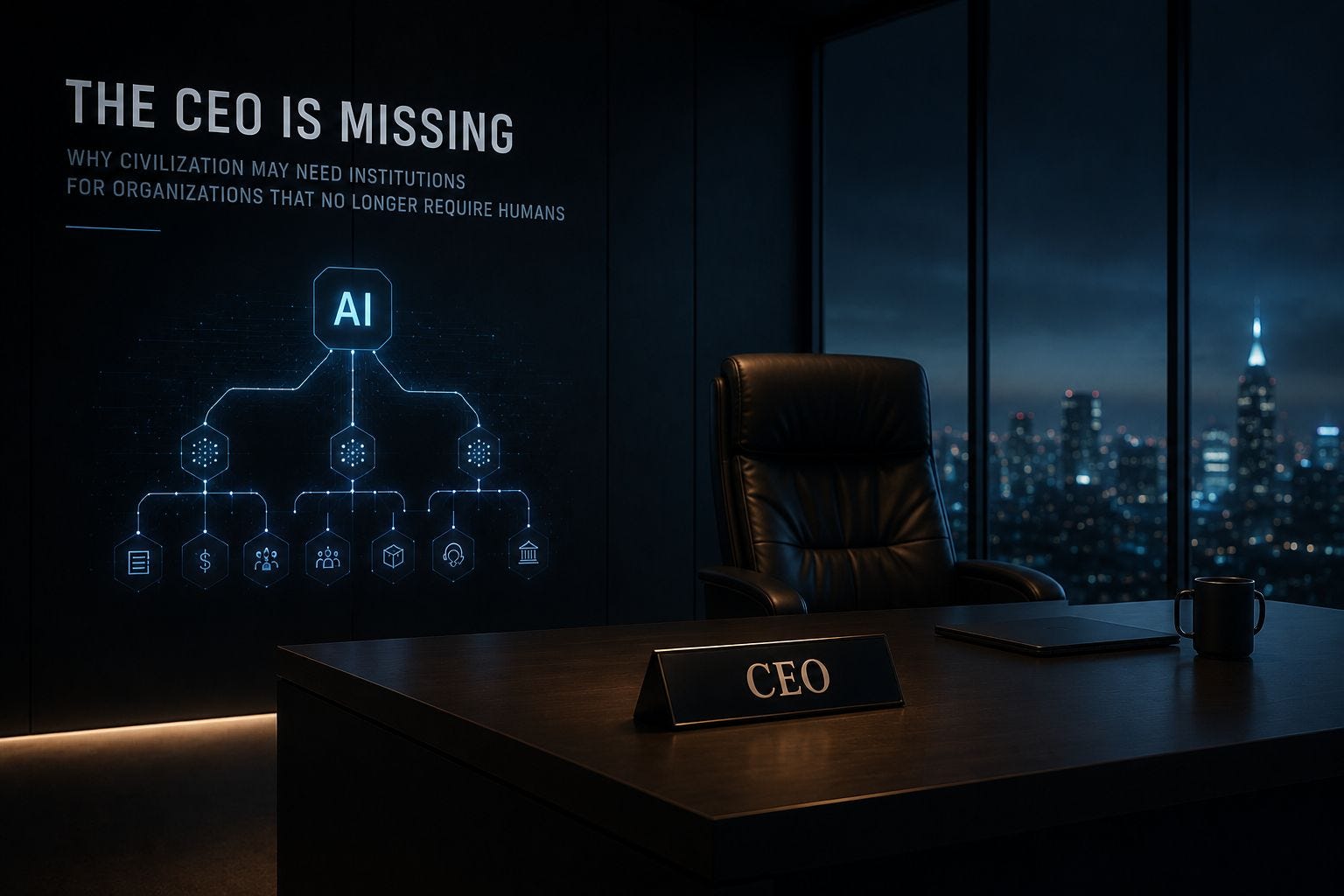
The CEO Is Missing
Why Civilization May Need Institutions for Organizations That No Longer Require Humans

The AI War Chronicles — Episode CXXIII
Dispatches from the Frontlines of the AI Era
Substrate Economics Series
If you read AI War Chronicles, you will:
* See what becomes non-optional before everyone else
* Spot what gets replaced before it happens
* Understand where power is moving — and why
---
⸻
The CEO is missing.
The board never meets.
Management no longer exists.
Yet the company continues operating.
Contracts are signed.
Invoices are paid.
Employees are hired.
Products are shipped.
Customers are supported.
⸻
At first glance, this sounds impossible.
Companies are human institutions.
They require leaders.
They require managers.
They require decision-makers.
Or perhaps they only required them because there was no alternative.
The first non-human persons were not artificial intelligences.
They were corporations.
Civilization granted fictional entities the ability to own property, enter contracts, accumulate capital, and outlive their creators.
The difference was that humans remained inside the loop.
Humans occupied the executive offices.
Humans signed the documents.
Humans absorbed accountability.
⸻
Artificial intelligence may challenge that assumption.
As AI systems become capable of making and executing increasingly consequential economic decisions, a new possibility emerges:
Economic agency without continuous human participation.
This does not require conscious machines.
It does not require artificial general intelligence.
It only requires systems capable enough that organizations increasingly depend on them to function.
That is where the real threshold may lie.
Not intelligence.
Dependency.
Because civilizations do not govern technologies.
They govern dependencies.
As long as artificial intelligence remains experimental, ambiguity is tolerated.
But once economic systems begin depending upon AI-mediated decisions, tolerance for ambiguity declines.
The question shifts.
From:
“Can AI do this?”
To:
“Who becomes responsible when it does?”
⸻
The CEO was never the point.
The point was accountability.
The executive office was where civilization parked accountability.
If organizations no longer require humans to operate, civilization must decide whether they still require humans to absorb liability.
Who answers in court?
Who governs institutions that increasingly govern themselves?
These questions may sound premature.
⸻
History suggests otherwise.
Governance rarely arrives before necessity.
It emerges after dependency forms.
After optionality narrows.
After society realizes the capability has become infrastructure.
Recent proposals in Argentina may represent the first visible attempt to construct institutional frameworks for non-human economic actors.
Not because machines have become people.
But because organizations may eventually cease requiring people in many of the roles that once defined them.
The first AI-native institution may not be government or the military.
It may be the firm itself.
For centuries, corporations evolved to coordinate capital, labor, and decision-making under changing technological conditions.
Artificial intelligence may represent the next redesign.
The strategic implications extend far beyond any single country.
Jurisdictions may begin competing to attract AI-native firms.
New markets may emerge around verification, auditing, insurance, institutional trust, and machine accountability.
⸻
The scarcity may migrate once again.
As intelligence becomes increasingly abundant, governance may become the bottleneck.
The deeper question is not whether artificial intelligence deserves personhood.
It is whether civilization is prepared for organizations that no longer require humans to operate.
⸻
Because the CEO is missing.
The company remains.
And civilization must decide whether accountability can survive once the human disappears from the organizational chart.
⸻
🔁 Share
***If this framework helped you see AI differently, share it with someone thinking about the future of technology.