
The Coordination Layer
When Agentic Systems Start Depending on Each Other

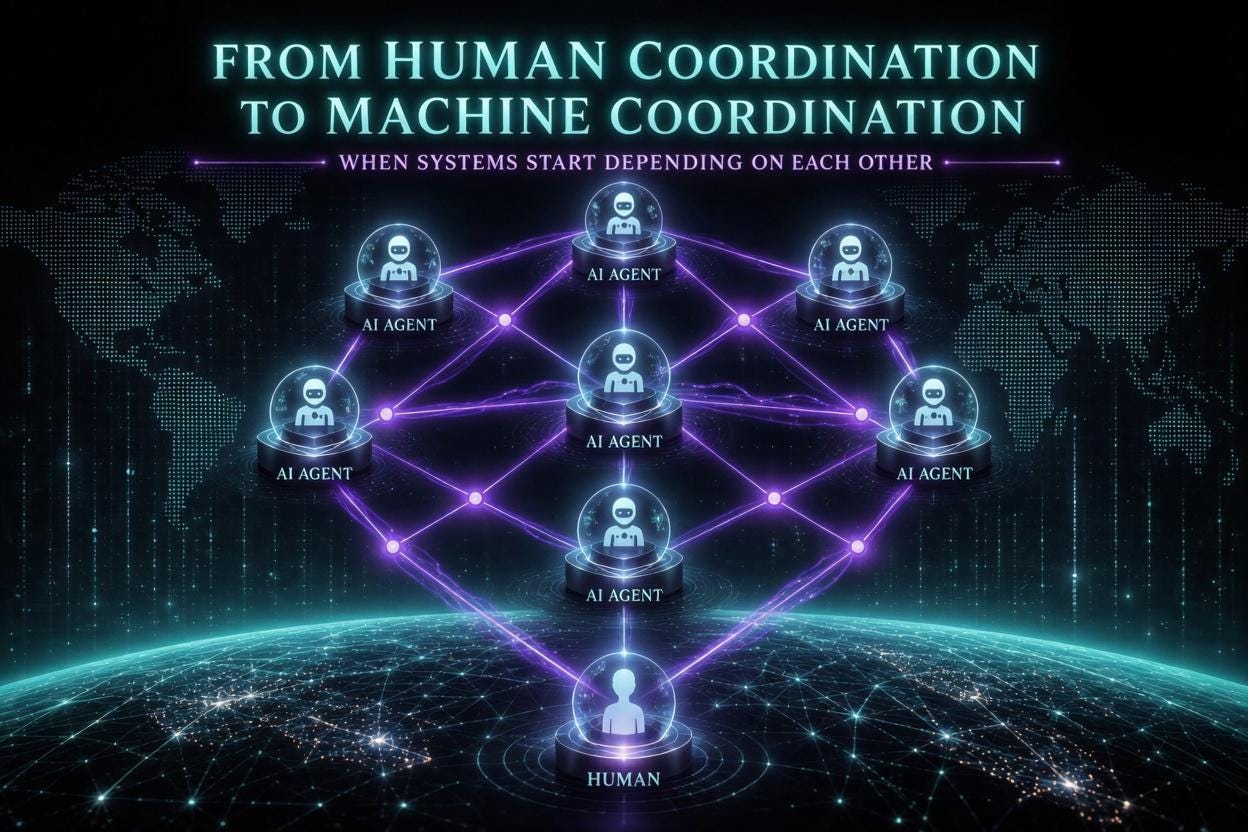
The AI War Chronicles — Episode XCIC
Dispatches from the Frontlines of the AI Era
Substrate Economics Series
If you read AI War Chronicles, you will:
* See what becomes non-optional before everyone else
* Spot what gets replaced before it happens
* Understand where power is moving — and why
---
⸻
The first phase of enterprise AI was assistance.
The second phase was execution.
The next phase may be coordination.
Because the deepest AI transition may not occur when organizations begin using autonomous systems.
It may occur when autonomous systems begin coordinating directly with other autonomous systems.
That is a much bigger threshold.
And it represents the transition from operational dependency to coordination dependency.
⸻
In embeddedness terms, this is the shift from L3 to L4 systems.
L3 embeddedness occurs when organizations begin depending on AI operationally.
L4 embeddedness begins when organizations start depending on machine-to-machine coordination itself.
⸻
That distinction matters enormously.
Because once systems begin coordinating directly with other systems,
human coordination increasingly becomes the bottleneck.
⸻
For the past few years, most AI systems still operated primarily inside human-supervised workflows.
Copilots assisted workers.
Agents executed bounded tasks.
Humans remained the orchestration layer.
But that architecture does not scale indefinitely.
Because once organizations deploy large numbers of autonomous systems,
human coordination introduces latency:
meetings,
approvals,
handoffs,
organizational friction,
communication bottlenecks,
and decision delay.
That creates enormous economic pressure toward machine-speed coordination.
⸻
The early signals are already visible.
Microsoft increasingly frames enterprise AI around multi-agent orchestration, autonomous business processes, and “systems of action.”
Salesforce openly describes agentic AI as “digital labor.”
OpenAI, Anthropic, Google, Microsoft, and enterprise infrastructure providers are all rapidly moving toward agent ecosystems instead of isolated copilots.
At the same time, organizations across finance, software, logistics, and operations are redesigning workflows around orchestration layers, agent routing systems, execution frameworks, memory infrastructure, and autonomous coordination environments.
⸻
That shift matters.
Because organizations are no longer merely experimenting with AI as a productivity layer.
They are beginning to explore AI as a coordination substrate.
At lower levels of embeddedness, AI behaves like software enhancement.
At L3, organizations begin depending on AI operationally.
But L4 changes the structure of the institution itself.
Because once systems coordinate directly with other systems,
organizations increasingly operate at machine coordination speed instead of human coordination speed.
⸻
That changes everything.
Coordination costs compress.
Decision latency falls.
Operational execution accelerates.
Human supervision narrows toward exception handling instead of continuous orchestration.
And increasingly, the organization itself begins behaving less like a human-coordinated institution
and more like a continuously executing system.
This is why the coordination layer matters so much.
⸻
Historically, organizations scaled through management structures:
meetings,
approvals,
reporting chains,
human oversight,
and communication systems.
But machine coordination collapses many of those frictions.
That is a profound organizational transition.
Because once coordination itself becomes autonomous,
organizations no longer scale primarily through headcount.
They scale through coordinated execution infrastructure.
That creates a much deeper form of embeddedness.
At L4 embeddedness, organizations no longer merely depend on AI tools.
They depend on AI-to-AI operational coordination itself.
That is a much harder dependency to reverse.
Because once workflows,
agents,
systems,
memory layers,
and infrastructure become interconnected through autonomous coordination,
removing the coordination layer creates cascading operational degradation across the institution.
⸻
That is how non-removability compounds.
Quietly.
System by system.
Workflow by workflow.
Coordination layer by coordination layer.
Until machine coordination itself becomes operational infrastructure.
This also creates a major shift in where power may concentrate.
Most people still think the primary winners of AI will simply be whoever builds the smartest models.
But intelligence alone does not create durable coordination power.
Embedded coordination infrastructure does.
That means the critical layer increasingly becomes:
orchestration systems,
coordination frameworks,
execution infrastructure,
verification layers,
memory systems,
identity systems,
and operational trust architecture.
Because once organizations structurally depend on machine-speed coordination,
removing that infrastructure creates compounding operational disadvantage.
That is how L4 embeddedness forms.
⸻
Why this matters to you:
The next phase of AI disruption may not primarily come from AI replacing individual workers.
It may come from organizations increasingly replacing human coordination itself.
Not because humans disappear.
But because routing,
scheduling,
workflow coordination,
decision escalation,
resource allocation,
operational monitoring,
and execution management increasingly move into coordinated agentic systems.
That changes:
* enterprise software,
* management structures,
* labor dynamics,
* organizational leverage,
* institutional dependency,
* and eventually the economic role of human coordination itself.
Because once organizations begin operating at machine coordination speed,
human organizational structures begin looking increasingly slow, expensive, and inefficient by comparison.
The first AI phase accelerated cognition.
The agentic phase automated execution.
The coordination phase may reorganize institutions themselves.
⸻
🔁 Share
***If this framework helped you see AI differently, share it with someone thinking about the future of technology.
The L3 to L4 transition is the right frame. And you’re correct that the critical layer becomes orchestration infrastructure, not model intelligence. Where I’d push further: coordination dependency becomes a problem at the decision level, not just the organizational level. The moment systems coordinate with other systems, the question isn’t whether human coordination is too slow, it’s whether each system in that chain has a decision architecture underneath it.
Without that, you don’t get coordination infrastructure. You get exposure. Every system executing confidently toward a shared goal with no mechanism to recognize when that goal is being pursued in a way that causes harm downstream. The verification layers and operational trust architecture you name at the close aren’t features you add to a coordination layer. They’re properties each agent needs before it enters coordination at all.
Good read!